1. Home
  2. Features
  3. AI summaries

AI summaries

Power dialer with after-call AI summaries and transcripts for recorded calls

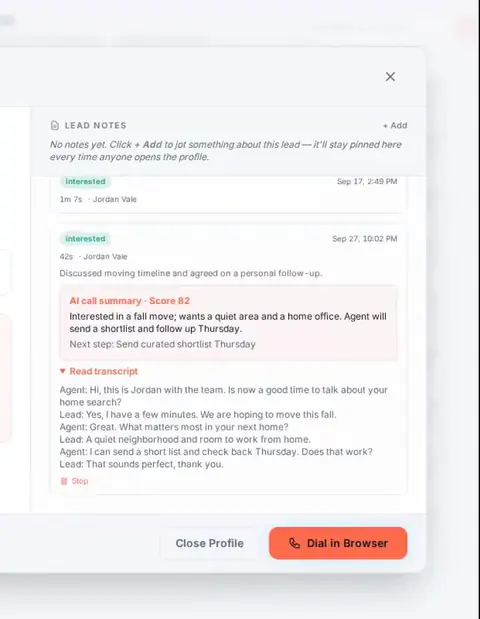
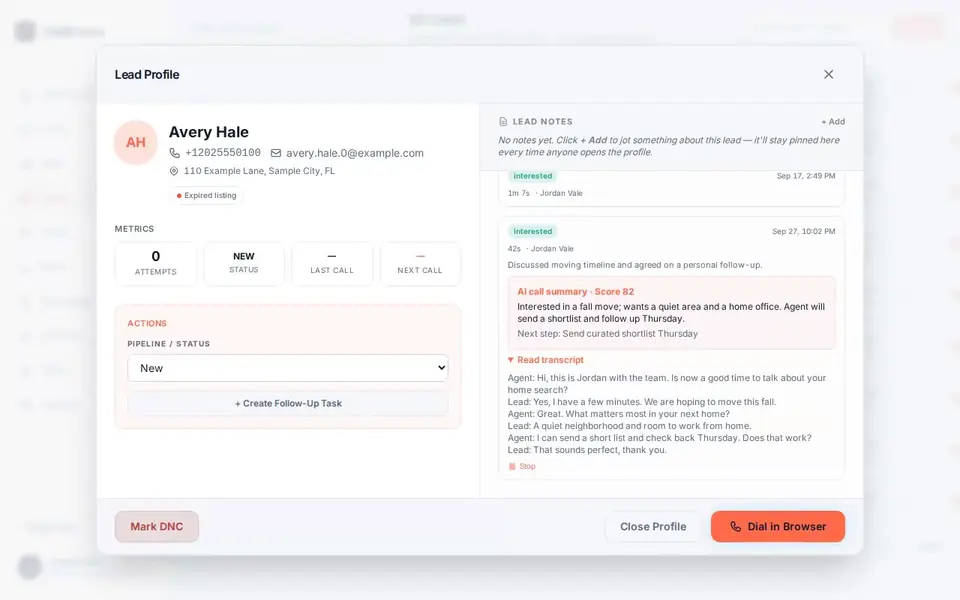
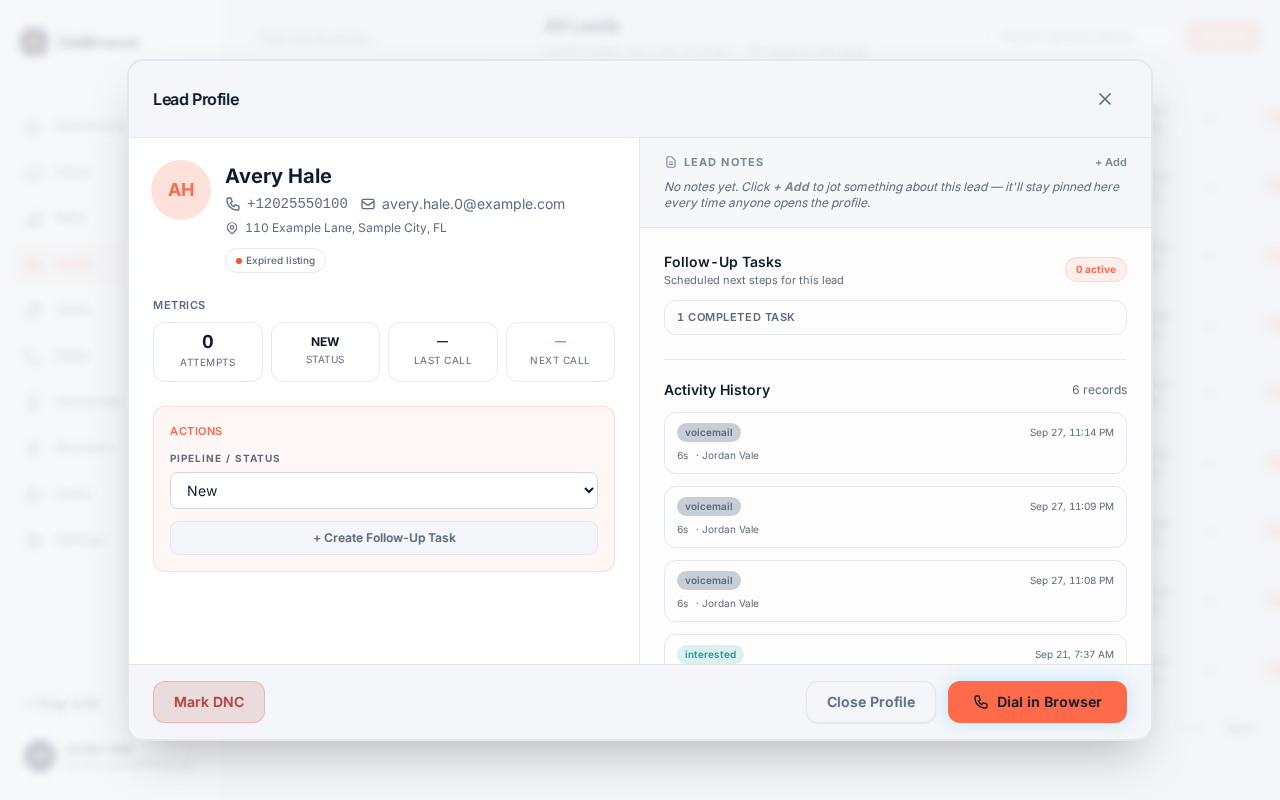
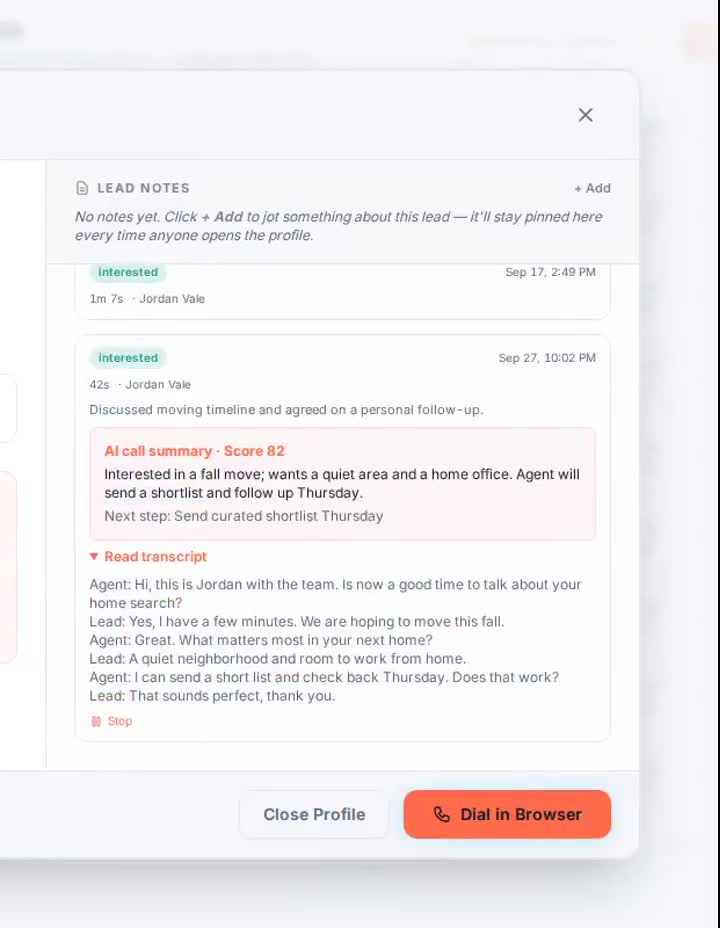
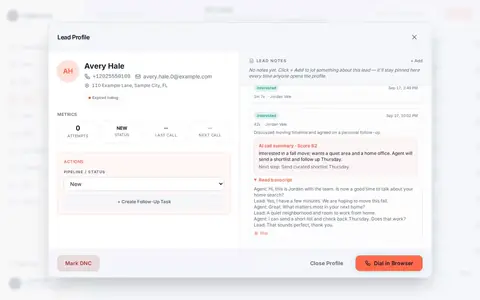
When the call ends, the after-call AI writes a plain-language summary of the conversation and files it on the call record: who the lead is, what they want, what was agreed. The person picking up the thread reads the summary first and listens only when the detail matters. It is a handoff, not a verdict.

Sample lead card with AI call summary and transcript displayed beneath it
Real product interface, seeded sample data. The summary is the subject; inspect the clip below.

Play authentic sample recording, review AI transcript/summary and create follow-up task. Screen recording of the product with seeded sample data; simulated calls. No narration or source-call audio is included. Pause or seek to inspect a frame.

How it works.

4 steps, in the order they happen during a session.

  1. 1

    Written after the call

    The worker processes the recording and produces a compact account of the discussion and the apparent next step. The operator's outcome and note stay separate and unchanged.

  2. 2

    Filed on the record

    Summary, transcript, score, disposition and note land together on the call record. The next reader gets one story, assembled in seconds instead of minutes, without replaying audio.

  3. 3

    Read, then verify

    Check names, dates, amounts and commitments against the transcript or the recording before anyone acts. The summary compresses, and compression can drop or bend details.

  4. 4

    Hand off with context

    A covering teammate, a licensed agent or an owner opening the queue reads what happened, sees the agreed next step, and takes over without replaying every call.

The specifics.

What the product does today. Plans from $25 per seat; three lines, voicemail drop and AI start at Pro, $49.

AI summary card and transcript on a sample lead
Real product interface, sample data.
Plain language
A compact account of the discussion and the apparent next step.
Real workload
9,367 summaries across a 90-day production snapshot, aggregate and anonymized.
Next step
The summary records the agreed follow-up, such as a same-day callback.
Together with
Transcript and fixed structured fields on the same call record.
Plan inclusion
Summaries are included on Pro and Team at no per-call charge.

One real call, summarized

The published real-call example shows the mechanism honestly. A four-minute-fifty-second production call from September 2026 ended in an appointment set. The summary read like this in substance: an early-stage retiree buyer, looking for a water-access single-family home in the southwest, open from Naples up to Tampa, cash purchase, no stated budget, no timeline, not under buyer's agency, agreed to a 5PM call and to receive listings at the email on file.

Every claim in that summary is traceable to the transcript, and the transcription errors were left visible on purpose. Names and contact details were redacted. This shape, a human-connected call with transcript, summary and fixed structured fields, exists on 13,311 calls in production use, and 9,367 summaries were produced in the 90-day snapshot. Those are workload counts, not outcome claims.

The summary earns its keep at handoff, when the person working the next step is not the person who had the conversation.

Use it without treating it as authority

A summary is a compression of a conversation, and compressions lose things. Read the outcome, the operator's note and the summary together, because they were written at different moments and can point in different directions. Open the transcript for any detail heading into written follow-up. Check the audio for anything consequential: an offer, a stop request, a specific commitment.

Keep uncertainty visible. If the summary preserves a refusal, the refusal survives the handoff. If the summary converts hesitation into interest, the reader needs to know that can happen. Confirm the follow-up task reflects what the lead actually agreed to before the caller acts on it.

Derived text deserves the same care as the call itself. Keep summaries inside the group that needs them rather than pasting them into broad channels. Summaries are included on Pro and Team, with no per-call charge.

Three outputs with different jobs

The after-call layer helps someone understand a recorded conversation without starting from scratch. It is not a replacement for the conversation or an instruction to contact the person again.

  • Transcript: a word-for-word transcription attempt from the audio. It helps locate wording, but names, dates, numbers and overlapping speech can be transcribed incorrectly.
  • Fixed structured fields: model-produced signals about the conversation. Read it as a prompt for review, not a probability of closing or a verdict on the operator.
  • Plain-language summary: a compact account of the discussion and apparent next step. Check any commitment before carrying it into follow-up.

The outputs can disagree with an operator's note or with the available recording. Resolve important differences against the source rather than choosing the most convenient version. The recording workflow explains how to prepare for source review.

Distinguish unfinished, unavailable and incorrect output

These are review categories, not a promise of particular status badges or processing times in the interface. Check what the actual call record shows.

  • Not finished: the call has ended but an expected output has not appeared. Check whether usable audio exists and whether processing is still in progress. Do not conclude either success or failure from an empty field alone.
  • Unavailable: an expected recording or output cannot be obtained. Record the affected call reference and ask support to investigate. Do not wait indefinitely or invent the missing content.
  • Incorrect: output exists but misstates a name, number, request or commitment. Check the audio and use the verified fact for the next action. Keep uncertainty visible where the source itself is unclear.

Complete the operator's required outcome and next-step record independently of the AI result. A missing summary must not become a reason to forget an explicit stop request or an agreed callback.

Use the structured fields to choose what to review

Fixed structured fields make a conversation easier to scan. During evaluation, ask what the displayed fields mean and compare them with the test recording. Do not assume that a high value predicts a sale, establishes consent or measures every aspect of an operator's work.

A useful review starts with a question. Did the operator establish the purpose of the call? Was the next step agreed? Does the summary preserve a refusal rather than converting it into interest? Listen for the relevant exchange before turning the result into feedback or a task.

Where a structured field seems inconsistent, keep the source reference and describe the discrepancy. Repeated examples can help the team investigate the model's behavior. An unexplained field value should not be promoted into an automatic customer-facing promise or a disciplinary decision.

Review and handoff

The after-call layer earns its keep at handoff, when the person working the next step is not the person who had the conversation. A covering teammate, a manager or an owner picking up a queue needs to know what happened without listening to the audio of every call.

  1. Read the outcome, the operator's note and the summary together; they were written at different moments and can point in different directions.
  2. Open the transcript for any detail that will appear in written follow-up, including names, addresses and numbers.
  3. Check the audio for anything consequential: an offer made, a requested stop, a specific commitment. This is where the summary stops being sufficient.
  4. Confirm the follow-up task reflects what the lead actually agreed to before the caller acts on it.

Handle derived text as you would the call itself. A transcript can reproduce sensitive detail that a lead said once in passing, so keep derived content inside the group that needs it rather than pasting recaps into broad channels.

A dated measure of after-call workload

Production use reported 9,367 AI summaries in the 90-day activity snapshot as of September 26, 2026. The count is aggregate and anonymized. It describes an output workload, not the number of qualified conversations, new customers or correctly completed follow-ups.

The separately reported 30-day AI coverage figure uses human connects with a summary and opportunity flag over human connects in that cohort. It must not be reconstructed from the 90-day summary total. The benchmark article owns the full dataset and its unresolved join limitations; the measurement guide explains how to establish your own matched cohort.

One real call, end to end (redacted)

Below is one real recorded call from production use, redacted: not a mock, not a script. It is a completed, recorded outbound dial from 2026-09-25: 4 minutes 50 seconds, ending in an appointment set, with a recording, a word-for-word transcript, fixed structured fields and a summary. Identifying details (the buyer's name and email, the operator's name) are redacted. The transcription errors are left in on purpose: they are what a real machine transcript looks like, and they illustrate why every output needs review.

What the operator heard (transcript, redacted)

Hi. Good morning. This is [operator] with [team name]. How are you, sir? Alright. That's great to hear. Well, I'm just reaching out about a home that you've checked out from our website. We just wanted to see if you're still looking to purchase a property or maybe just exploring for now. I'm just looking around right now. Just looking, sir. Correct? Yeah. Oh, yeah. That's perfect. Do you have any specific time line if when you're going to start the buying process or be in a home? I don't know yet. Mhmm. Yeah. Because if you'd like to, we can also send you some listings of the home that you, you're looking for. May I know if what kind of home are you looking for? Water access. Mhmm. Single family home? 5454 are you located? Southwest. Yeah. Mhmm. Water access single family home. How many beds in that? No. No less than three bedrooms. Least two bathrooms. Three car garage. Uh-huh. Cool. From 2,200. I'm so sorry, sir. Go ahead. Around 2,000 square feet. Two k square feet. Are you okay with existing construction, or you'd like a new one? Doesn't make any difference. Okay. I see. Gotcha. And, also, any areas that you're interested in, like maybe the southwest or you haven't, decided yet? I've been looking around, and my my go as far south as Naples. Mhmm. And all the way up to like, Tampa. Got it. Thank you so much. And any, specific budget or price point you wanted to stay under? No. I see. Awesome. And, are you paying cash or, you need help for preapproval or you're already preapproved? No. It's gonna be cash. Oh, cash. Got it. And I believe you are not working with any agent yet. Right? Well, yeah, I'm you know, I'm not work I don't under any kind of a buyer's agency with anybody right now, but I'm not gonna I see. Go under a buyer agency. I see. Got it, sir. And, also, is this, like, for your retirement, for your work, for your family? Just retirement. Mhmm. Wow. Congratulations to you. Yeah. We'd love to show you, like, a tailored plan to help you with your home search. Would it be okay if one of our agents can give you, like, a quick phone call, later today at 5PM? Sure. Go ahead. Okay. Okay. Awesome. And for us also to send you some listings, your email address that we have here, is it [reads the email on file]? No. Oh, what's your best email for us to send you some listings? That's the best email. Okay. A h a, [email redacted]? Yep. Okay. Awesome. Yeah. Just keep your lines open later today at 5PM, and I'll go ahead and forward your criteria to one of our agents, so that we can narrow down the search for you. Okay? Okay. Bye. Awesome. Really do appreciate your time, sir.

Verbatim transcript from that recorded call, with names and contact details redacted. Note the errors the model actually produced: a mangled readback of the email address, and "5454 are you located" for "where are you located". A published example with no errors would be the suspicious one.

What the AI returned from that call (fixed structured fields)

Lead intent
buyer
Geography
Southwest, open to Naples through Tampa
Criteria (summary text, not a dedicated field)
water-access single-family; 3+ bed, 2+ bath, 3-car garage, ~2,000 sq ft; existing or new build
Price band
not stated (no cap given)
Timeframe
not stated ("I don't know yet")
Objections
"Just looking / no defined timeline"; "won't sign a buyer's agency agreement"
Next step
callback agreed for 5PM the same day; send matching listings to the email on file
Flags
hot: no · wrong person: no · do-not-call signal: no · Spanish-speaking agent needed: no

The summary a teammate would read

An early-stage retiree buyer looking for a water-access single-family home in the southwest, open from Naples up to Tampa. Criteria: 3+ beds, 2+ baths, 3-car garage, ~2,000 sq ft, existing or new construction, cash purchase, no stated budget cap. Not under buyer's agency and said he does not intend to sign one; no defined timeline yet. Agreed to a 5PM call today and to receive listings at the email on file.

Redacted from the summary the system actually wrote for this call. The structured fields above are the real values from the same call's record: not reconstructions.

What to check in it

The point of showing this is the review habit it teaches, not a promise that every call looks this clean. Source audio is withheld for privacy. Read the redacted transcript, then the structured fields, and ask of each line: is this supported by the source, is it the model's interpretation, or is it uncertain? Here the criteria and the two objections are firmly supported by the transcript; the "5PM" and the email are stated by both parties and safe to act on. Confirm names, numbers and any commitment against the recording before you rely on them: and inspect an unavailable-output case too, so an empty record is never mistaken for a finished review.

Provenance & auditability. Source: a production dialer call record, 2026-09-25 13:32:20 UTC, outbound, 290 seconds, disposition appointment_set, transcript provider Deepgram nova-2, recording present. Values reproduced from that call's own transcript, summary and structured-output fields.
Record digest (for internal verification; raw source fields are not public): of the source record's raw fields: transcript e46eafe0… · summary 7aeee888… · structured output 9a795e8c…. These are content hashes of the exact stored fields this page reproduces; if anyone with production access re-runs them against that call id and gets the same digests, the excerpt above is unmodified.
Not a one-off. This shape: a human-connected call with a transcript, a summary and fixed structured fields: exists on 13,311 calls in production use, 60 of them ending in an appointment set. This is one of them, not a rare demo.
Redactions: buyer name, buyer email, operator name. No phone number appears in the source record.
We publish this redacted transcript and structured fields, but not the private recording. A visitor cannot verify them against the original audio: the transcript includes recognition errors; visitors cannot independently verify the source audio.
How to review any record

During setup, ask to inspect a permitted test recording and the outputs actually produced from it. Start with the source audio, then compare the transcript, structured fields and summary. Use the same call reference throughout the review.

Check one ordinary detail, one next-step statement and one point that could be misheard. Can the reviewer tell what is supported by the source, what is the model's interpretation and what remains uncertain? Then inspect an unavailable-output case so a blank record is not mistaken for a completed review.

Finish by writing the operator's outcome and follow-up task from the verified information. This is an evaluation procedure, not a fabricated production-call example. It demonstrates the standard a real result should meet without presenting scripted dialogue as customer evidence.

Included on Pro and Team

Transcription, structured fields and summaries are included on Pro at $49 a month for one dialing seat and on Team at $79 a month for two dialing seats, plus $20 per added dialer. Starter at $25 does not include the AI layer. There is no per-call AI charge. See pricing, and how transcription works for the pipeline and its limits.

Review before the next consequential action

Outputs can be delayed, unavailable or incorrect. Check important wording, names, dates, numbers and commitments against the available source. A structured field is not a sales prediction, and a summary is not authorization to contact someone. The operator remains responsible for the actual outcome and agreed next step.

See the after-call record on a test call

Setup is assisted: a person on our team provisions your workspace, and there is no free trial or instant self-serve signup. After provisioning, you connect your own Telnyx account and real calling lists. Same-business-day provisioning is our target, not a guarantee. Test calls cannot be used to benchmark outcomes on real prospects. Request setup.

Questions about ai summaries.

Straight answers. Anything else: email support.

Does the AI write this during the call?
No. The summary is produced after the call, from the recording, by the after-call worker. The AI never joins a live call, never speaks to a lead and never decides who gets dialed. The operator finishes the disposition, note and follow-up independently, so a missing summary never becomes a reason to forget an agreed callback.
Are summaries reliable enough to act on?
As a handoff, yes, with verification for what matters. Production use produced 9,367 summaries in a 90-day snapshot, so the pipeline runs at volume. But summaries compress, and compression can drop or bend a detail. Check anything consequential, names, numbers, commitments, against the transcript or recording before it drives an action.
Can a summary replace the operator's notes?
No. The operator's outcome, note and follow-up task are the record of what a human decided. The summary is derived text that helps the next reader. Complete those operator records independently of the AI result, and read all three together when you pick up a lead: they were written at different moments and can disagree.
What does a summary look like?
A few sentences in plain language: who the lead is, what they want, what was agreed. In the published real-call example it covered the buyer's criteria, geography, payment plan, an objection about buyer's agency, and a 5PM callback agreement. The transcript and fixed structured fields sit beside it on the same record, so the detail is one click deeper.
Is there a per-summary charge?
No per-call charge. Summaries, transcripts and scores are included on Pro at $49 a month and Team at $79 a month for two dialing seats, plus $20 per added dialer. Starter at $25 does not include AI. Your Telnyx account bills carrier usage separately at Telnyx rates.

Try it on a real session.

Setup is assisted. A person on our team creates your workspace, admin login and dialing seats after you choose a plan or send a setup request; there is no instant self-serve signup. Calls run on your own Telnyx account (bring your own), which Telnyx bills separately, and need an eligible calling list. The request form takes no payment and does not create an account.

Request setupPricing