1. Home
  2. Industries
  3. Home services
  4. Solar sales teams

Power dialer for solar sales teams

How solar sales reps run quote and consultation follow-up on DialBreeze: three lines per rep, call recordings when recording is on, and an AI summary that can describe the utility, the bill, the roof details and the objection that decides the appointment.

Updated September 28, 2026Home services

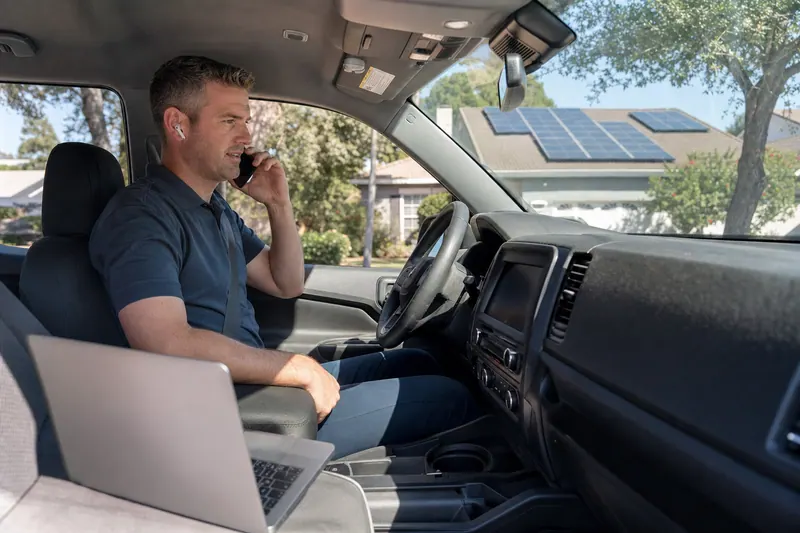
A home services rep on a call from his truck, solar panels on the roof behind Illustration, not a customer photo.

The short answer

DialBreeze is a browser power dialer for solar reps following up on quote requests, site assessments and event leads. It rings up to three numbers at once, records calls when recording is on, and after the call is processed writes a summary that can describe the utility, average bill, roof details, system interest and the objection standing between the lead and the site visit. The rep does all the talking. Calling runs on your own Telnyx account.

A calling day for solar sales teams.

The moments where a dialer, a recording and an after-call note change the outcome. Illustrative, not a customer story.

  1. 8:30 AM · the rep opens a list of 70 homeowners who requested quotes or scanned the booth QR code at the home show, newest first.

  2. 8:50 AM · three lines ring. One voicemail gets the recorded drop, one never picks up, the third answers: a homeowner with a $290 summer bill and a south-facing roof. The rep asks about the utility, shading, HOA and whether the spouse is home for a site visit.

  3. 9:00 AM · disposition 'Site assessment booked', Saturday morning. The AI summary is on the lead: utility, $290 July bill, south roof, new in 2019, HOA approval needed, spouse skeptical of lease products.

  4. 1:00 PM · old-quote block. Leads quoted 60 to 90 days ago when rates or utility tariffs changed get re-called with the reason in the summary attached.

  5. 4:30 PM · the sales manager replays three calls where the homeowner balked at the payback question, and cuts the jargon from the script.

The workflow, list to follow-up.

The same four moves every session, described the way solar sales teams work.

  1. Import the lead list as a CSV with source, utility and any bill or roof notes. Your internal DNC list, quiet hours and attempt caps apply before the session.
  2. Dial up to three lines. Take the live answer; drop your recorded voicemail on the rest.
  3. Disposition in solar terms: Site assessment booked, Callback, Send proposal, HOA approval pending, Not interested, Wrong roof (rental/shade), Do not call.
  4. After the call is processed, the AI note can describe utility, bill range, roof age and orientation, and the objection, so the proposal reflects the actual house and the actual hesitation.

What the notes look like after a call.

When recording is on, DialBreeze transcribes the call and writes a summary with a suggested next step after the call is processed. The summary can describe details like the ones in this card; they are not dedicated fields for this job. The card is a sample with fictional data. Check important details against the recording.

Fixed structured fields, same for every team: lead intent, timeframe, price band, geography, language, objections, next step, and flags for hot lead, Spanish-speaking agent needed, do-not-call signal and wrong person. The prompt is tuned for real estate calls; fields are not configurable per industry.

Outcomes to record in this workflow

  • Site assessment booked
  • Callback
  • Send proposal
  • HOA approval pending
  • Not interested
  • Wrong roof
  • Unreachable
  • Do not call

DialBreeze has ten fixed dispositions, such as appointment set, callback, not interested and do not call. Pick the closest one and record the specific outcome in the note.

Information the summary may describeSample
Intent
Quote follow-up, purchase interest
Utility
Regional co-op; net metering confirmed at 1:1
Bill
$290 July average; ~$160 shoulder months
Roof
South-facing, replaced 2019, minimal shading
Household
Married; spouse decides jointly, distrusts leases
Objection
Payback math unclear; wants 25-year comparison in writing
Next stepSite assessment Sat 9:00 AM; bring purchase vs lease comparison and HOA packet

The follow-up call decides the install

A solar quote request is a hand raised, not a sale. The follow-up call is where the hand becomes a site assessment: utility, bill, roof, HOA, spouse. Reps who treat the lead form as the qualification are competing on price with every other company that emailed a PDF. Reps who call within hours, ask the five questions and book the assessment are competing on attention, which is where solar is actually won.

Speed matters because interest decays. A homeowner who scanned a QR code on Saturday is cold by the following Friday. The morning block goes to the newest requests, every day, without negotiation.

The five questions that build the proposal

Utility and tariff, bill range by season, roof age and orientation, shading and HOA, and the household decision structure. Each one changes the proposal: net-metering terms change the math, a 2019 roof changes the risk conversation, an HOA changes the timeline, and a skeptical spouse changes the meeting. The AI summary holds all five in the homeowner’s own words, so the Saturday visit starts where the phone call ended.

That summary is also why the objection never gets lost. “Distrusts lease products, wants payback in writing” attached to the lead means the rep arrives with the comparison document, not a faster pitch.

The consumer-protection reality of solar

Solar draws more regulator attention than almost any home service: savings and production claims must match the roof and the tariff, licensing and disclosure rules vary by state, and the complaints that stick are the exaggerated ones. The discipline that protects you: quote production from the actual roof, put payback claims in writing, never promise bill elimination. The recording backs all of it, provided the disclosure and consent rules are respected in all-party states. Nothing here is legal advice.

Dispositions that keep the pipeline honest

Site assessment booked, callback, send proposal, HOA approval pending, not interested, wrong roof, do not call. “Wrong roof” (rental, heavy shade, replacement due) is a real outcome that saves the design team hours. “HOA approval pending” is a dated follow-up, not a maybe.

The tariff moment: re-calling old quotes

Utility rate changes, tariff fights and life events reopen old quotes. Solar quotes stall for reasons the follow-up call can actually address: the financing comparison never arrived, the utility’s tariff changed, the roof question stayed unanswered, the spouse never saw the numbers. The original summary names the stall, and the re-call opens with it: “your co-op changed its net-metering terms last month, so the math we discussed changed.” That is an honest reason and a real deadline, which is what the re-call has to offer.

Rate events and utility tariff fights are the honest calendar for this list. A block after every rate announcement, worked with the old summaries attached, gives re-opened quotes a concrete reason to talk again. The summary’s utility and bill details make the re-call specific to the household instead of a blanket discount panic. Run it as its own campaign so the re-opened quotes report separately from the fresh-lead numbers. This is an illustrative workflow, not a measured conversion result.

Managing a sales floor from the tape

The manager’s view of a solar floor used to be ride-alongs and hunches. With connected calls recorded (when recording is on) and summarized, the week’s coaching material builds itself: the calls where the payback question got dodged, the calls where the homeowner’s objection was never asked about directly, the calls that ended without a site visit on the calendar. The AI summaries and hot flag triage which calls are worth the replay; the manager picks two per rep, not twenty, and the coaching lands on real sentences instead of hypotheticals.

The same tape protects the company. When a homeowner later recalls a production promise nobody made, the recording shows what was actually said, and the rep who stayed inside the verifiable claim has nothing to worry about. The AI summaries give management a record of the savings claims made across the floor, so the coaching happens before the regulator’s letter.

New reps onboard against the same library: annotated calls of a clean qualification, a careful tariff answer, a do-not-call handled correctly.

Keep the appointment handoff specific

The site assessment inherits whatever the homeowner actually said: utility, bill range, roof age and orientation, HOA status, and who decides. That is customer-reported information, and the dialer validates none of it. Make the handoff specific: confirm the date and time, who should attend, and what the rep promised to bring. The proposal numbers wait for the site assessment, because the roof and the tariff decide what is true.

What you need to start

  • Your own Telnyx account with numbers and caller ID.
  • Lead lists as CSVs with source and any utility or roof notes.
  • A recording disclosure and one headset per rep.
  • A disposition set the whole sales floor uses.

Setup is assisted and calls run on your own Telnyx account, so start with a small eligible batch. Load a sample lead list, run a three-line block, and read the summaries before real homeowners are dialed.

Calling rules to check first.

  • TCPA
  • Telemarketing Sales Rule
  • National DNC and internal DNC
  • Recording consent
  • State contractor licensing and consumer-protection rules

Calls to homeowners who requested quotes are consumer telemarketing: the FTC Telemarketing Sales Rule (16 CFR 310.4) requires truthful identity and purpose disclosures, 8 AM to 9 PM local time, DNC compliance unless an established business relationship or consent applies, and honoring opt-outs immediately. The FCC's prior express written consent definition is in 47 CFR 64.1200(f); the 2024 one-to-one consent rule was vacated in January 2025 and is not current law, but keep the consent evidence from your lead forms regardless. Solar is a consumer-protection hotspot: savings and production claims must match the roof and the utility's actual tariff, several states impose contractor licensing and specific solar disclosure requirements, and exaggerated bill-elimination claims draw regulators. Several states also require all-party recording consent; use a disclosure. DialBreeze enforces your internal DNC list, quiet hours and attempt caps; claims accuracy is yours.

This is operational guidance, not legal advice. DialBreeze enforces the internal DNC list, quiet hours and attempt caps you configure; consent and list eligibility stay with you. How the responsibility splits.

DialBreeze is not a fit if…

Better to know now than in week two of setup.

  • You want AI voice agents qualifying homeowners. Solar buyers smell a script fast; human-led calls are the point.
  • You need design, proposal or permitting tools inside the dialer. DialBreeze is the calling workflow next to those.
  • You rely on predictive dialing across a large sales floor. DialBreeze is up to three lines per rep.
  • You expect the dialer to validate consent on purchased leads. Keep that evidence in your lead records.

Questions from solar sales teams.

Something missing? Email brayden@themilnerteamfl.com.

What should the follow-up call establish?
Utility, bill range, roof age and orientation, shading, HOA, and who decides in the household. That is the difference between a proposal that fits and one that gets shelved. Book the site assessment where the spouse can attend.
What does the AI capture?
A transcript plus a plain-language summary; DialBreeze's structured signals are a fixed set (intent, timeframe, objection, next step, hot flag). The specifics (utility, bill range, roof details, product posture (purchase vs lease), the objection and the next step) appear in the summary text, not in industry-specific fields. The proposal then matches the house and the hesitation.
Can we re-call old quotes?
Yes, and rate changes or utility tariff changes give you an honest reason. The summary from the first quote explains what stalled it, so the re-call addresses the real objection instead of starting over.
Is cold calling homeowners allowed?
Cold calls to numbers on the National Do Not Call Registry are not allowed for telemarketing absent an applicable exception. Work your quote requests, event leads and consented lists; run anything broader past counsel. DialBreeze enforces your internal DNC list on top of your list policy.
Do recordings help with disputes?
Yes. When a homeowner later says they were promised a specific production number, the tape shows what was actually said. All-party consent states require a disclosure.
What does it cost per rep?
Starter is $25 a month for one dialing seat. Pro is $49 a month and adds three lines, voicemail drop and AI summaries. Team is $79 a month for two dialing seats, plus $20 for each added dialer. Your Telnyx account bills calling and numbers separately. AI is included on Pro and Team.

CRM reality, before you switch.

DialBreeze imports and exports CSV and can send signed disposition webhooks. There is no native two-way CRM connector today. Test the exact handoff your team needs during setup before switching.

What connects today

Checklist for the handoff

  • Import a small CSV with your real column layout, using synthetic rows, before a real list.
  • Send one disposition into your actual CRM or automation through the signed webhook.
  • Export the leads to CSV and check the columns your CRM expects.

See the workflow on your own list.

We set up your workspace, you connect your own Telnyx account and run a first controlled session, then you decide how to scale.

Request setupPricing